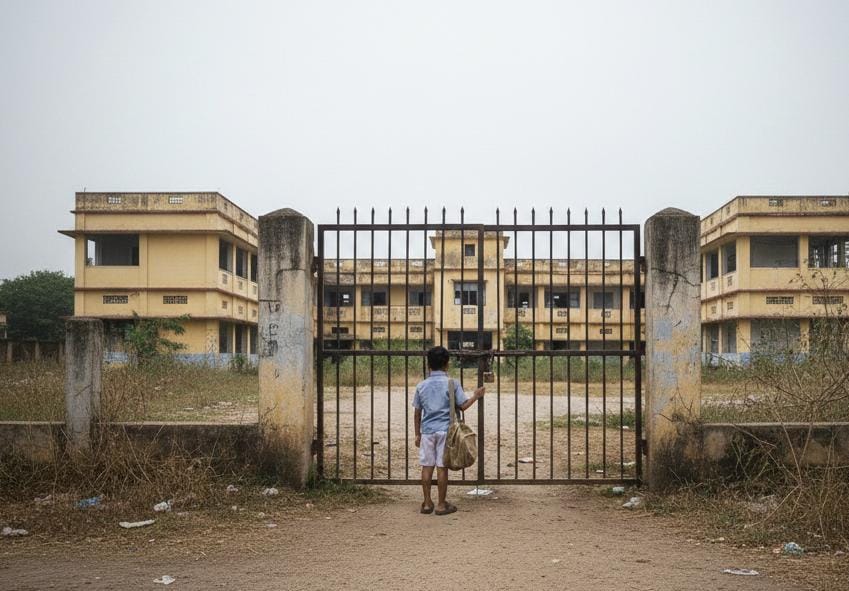
Closures, Overcrowding, and Lack of Basic Facilities in Delhi Schools, Says DSF Report
A report on the Status of School Education in Delhi, released by the Delhi Science Forum (DSF) and the All-India People’s Science Network (AIPSN), highlights serious problems in the city’s public education system as Delhi begins implementing the National Education Policy (NEP) 2020 in government schools from mid-2025. The report states that school mergers, closures, overcrowding, a lack of basic facilities, and teacher shortages have reduced access to government schools, especially for underprivileged students.
Speaking during a call with CauseBecause, Kamala Menon, general secretary of the Delhi Science Forum, emphasised the importance of inclusive policy action. “School education must be available for everybody, and access should be there to all children regardless of what class they come from or what family background they have,” she said.
According to official Unified District Information System for Education Plus (UDISE+) data cited in the report, the total number of schools in Delhi reduced from 5,642 in 2020–21 to 5,556 in 2024–25, with government schools declining from 2,751 to 2,681. Government school enrolment peaked at nearly 28 lakh students in 2021–22 but fell by over 3.3 lakh students by 2024–25. During the same period, overall enrolment across all schools dropped by more than 1.37 lakh students.
The report attributes this decline to the merging of around 100 government schools between 2022 and 2025. It notes that these mergers led to overcrowded classrooms, longer travel distances, and limited seats, resulting in around 80,000 children being unable to secure admission in recent years due to capacity shortages created by the consolidation.
In addition, the report points to other challenges. It notes that dropout rates increased from 4.8% to 8.3% over four years, particularly at the secondary level. The report also highlights the reintroduction of detention in Classes 5 and 8, with nearly 20% of Class 8 students detained in the first year. It further states that around 10,000 teaching posts remain vacant, MCD schools face a vacancy rate of over 33%, and only about 60% of sanctioned posts are filled by regular teachers, leading to increasing dependence on contract-based teachers, including guest teachers and Samagra Shiksha teachers.