This Swedish Mall Is Changing How the World Shops

Let’s be honest here: Most shopping malls feel the same. The same bright lights, loud salesmen convincing you to buy their lavender shampoo that is on a 60% discount ‘just for today’, racks of identical products stacked in endless rows, waiting to be purchased and then replaced again in a few months.
Shopping malls are the poster children of linear economy. In a linear economy, the process is simple: take resources, make products, and dispose of them after use. This model depletes finite resources and generates waste at every step.
But there exists a mall where nothing you buy is new, not because it’s anti-consumer or is trying to shame you for buying something you like, but because it was built on a very foundational question: why are we so quick to replace what can still be preserved, repaired, or recycled?
I know it sounds highly improbable, but stay with me, I promise you this place exists, and has been functioning as a real retail space since 2015.
Introducing ReTuna
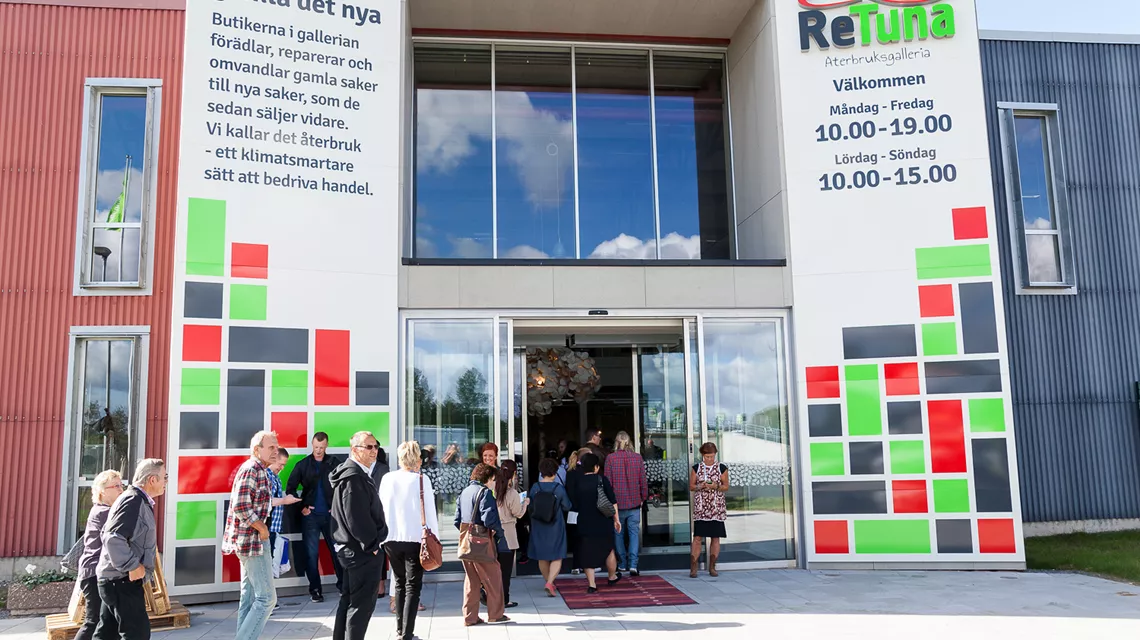
Welcome to ReTuna, a Swedish mall situated in the quiet sleepish town of Eskilstuna, a modest city that was never in the global headlines – until now.
In many ways, ReTuna is like a ‘regular’ mall; it’s big, clean and spacious, offering the shoppers all types of goods and all sorts of brands from the high-end likes of Michael Kors, Gucci or Apple electronics, through to more mainstream products. Everything is in good condition – but here’s the catch: all the products are second-hand.
The idea was born in 2012, after the municipality board of Eskilstuna decided the community needed a new recycling center. Following a pilot study, the council concluded that such a center could do more than reduce waste – it could also generate employment and raise awareness of circular economy principles.
Challenging the dominant “take, make, dispose” economic model, ReTuna was created to build a regenerative system centered on durable design, repair, maintenance, reuse, and recycling. These principles lie at the heart of the circular economy approach. The mall positions itself as a practical alternative to waste-heavy retail.
How the Mall Works
ReTuna starts to make sense the moment you see where it is.
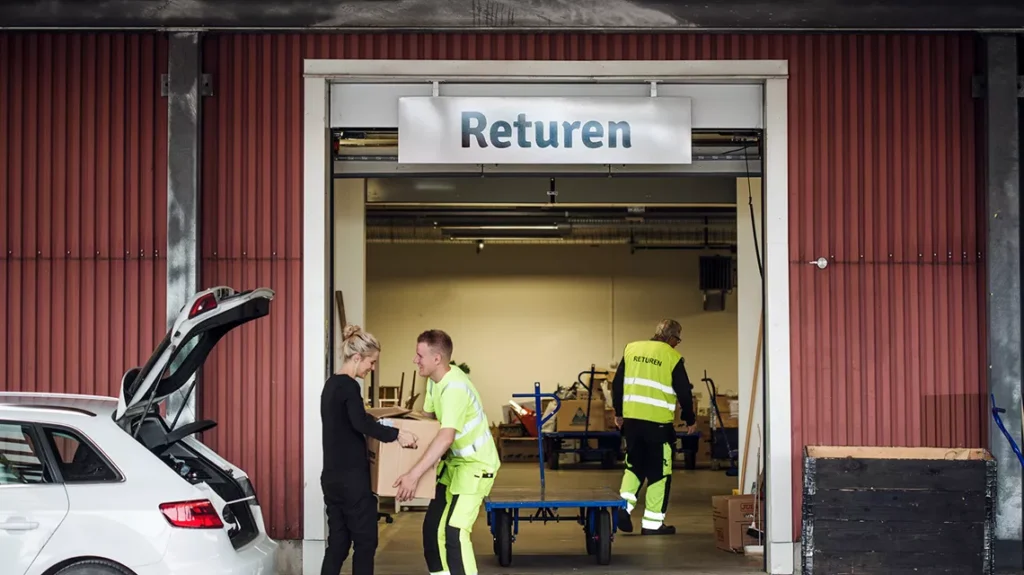
The mall opened its doors in August 2015 and is located right next to the city’s recycling centre. This makes it easier for visitors to drop off unwanted and reusable items at the mall’s depot or ‘Returen’. Depot staff sort what is usable and what isn’t, and then distribute the retained items to the mall’s shops. Shop staff then carry out further sorting, choosing what they want to repair, fix, convert, improve , reinvent, and ultimately sell. In this way, the materials are given new life.
And interestingly enough, the business seems to be working: in 2018, ReTuna generated SEK 11.7 million in sales from recycled products. Employment has also steadily grown; today, the mall supports around 83 jobs, with expansion plans expected to create another 15–20 positions in the near future.
Making Repair Visible
One of ReTuna’s most noticeable features is that their repair work is often visible to shoppers. Many stores operate on-site repair workshops, where customers can actually see how items are fixed, restored, or redesigned.
A broken chair, for instance, may be repaired and polished in the open rather than taken into a backroom. Electronic devices are sometimes opened and repaired on the spot, while clothes are stitched, altered or reworked into new products. One example is shopkeeper Maria Larsson’s container shaped like a pine cone, made from pieces cut from worn leather jackets.
Seeing the repair process can shift how visitors think about discarded products. It can remind people that products aren’t disposable by nature, but rather it is consumerism that has taught us to treat them that way.
ReTuna also aims to support repair skills beyond retail. Adults can enroll in a one-year recycling design program, learning craftsmanship and sustainable production methods. The city’s Makerspace membership program further allows residents to learn from each other, repair products, and experiment with reuse initiatives.
Visitors come for different reasons. Some arrive specifically looking for second-hand options, while others stop by out of curiosity.
In contrast to the linear model, the circular economy is built on principles of designing out waste, keeping products and materials in use for as long as possible, and regenerating natural systems. It calls for businesses to rethink how products are designed, how materials are sourced, and how goods are recovered and reused. It’s a shift from disposable to durable, and from extraction to regeneration.
And the success of ReTuna puts emphasis on the fact that circularity is not a niche topic; it is a viable economic model that can deliver resilience, efficiency, and long-term value creation across industries.
More Than a Place to Shop
The idea behind ReTuna was to sell more than just goods. And it tries to do so by conducting workshops,lectures and sustainability themed days to educate the people about conscious living.
Eskilstuna Folkhögskola, the local folk high school, offers its one-year program, Recycle Design – Återbruk, in the building. There are also conference rooms available for climate-conscious meetings, along with Café Returama, which serves organic lunches and baked goods.
These sessions don’t just target environmental professionals or activists – the aim is to teach in a simplified manner so that people from all walks of life can follow up. These sessions witness attendance from concerned citizens, students, families, and small business owners who could also learn about how to make sustainable choices for the planet.
Changing Consumer Behaviour
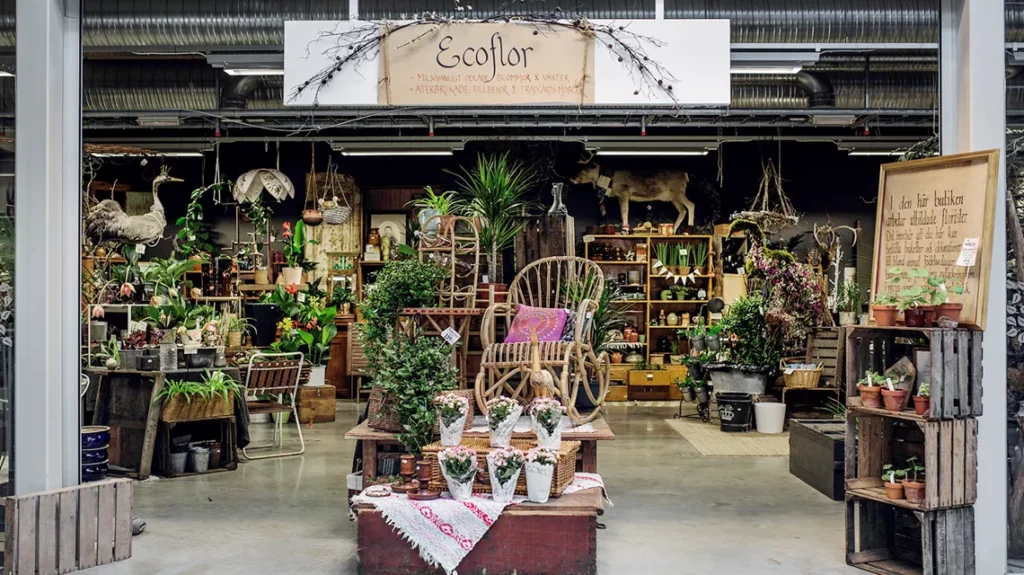
ReTuna aims to attract a broad range of visitors, though certain groups appear more drawn to the concept, including families, students, seniors, environmentally conscious shoppers and what staff describe as “treasure hunters” looking for unusual or vintage finds. At the same time, second-hand shopping still carries hesitation for some consumers, particularly those accustomed to buying new products or concerned about durability and choice.
According to mall staff, many visitors say their perception of reused goods shifts after spending time at the mall, as the quality and presentation challenge common assumptions about second-hand items. However, changing long-established consumption habits remains gradual, and reuse retail continues to appeal more strongly to certain segments than to mainstream shoppers.
Challenges and Lessons Learned
Of course, running the world’s first fully circular shopping mall isn’t all smooth sailing. Neither is it all roses and sunshine. Changing how people think about consumption takes time. Getting everyone to shift from a “throw it away” mindset to a “let’s fix or reuse it” mindset is still an ongoing journey.
Then there’s the practical stuff. Despite its success, ReTuna faces challenges common to reuse-based retail. The supply and quality of donated goods can vary, making it difficult for shops to maintain consistent inventory. Larger items such as furniture also require significant storage and transport space, which limits how much can be handled at a time.
First, you need politicians and decision-makers on board. Projects like this don’t just help the planet–they create jobs, new businesses, and stronger local economies.
Second, the money side needs careful planning. Sustainable projects need long-term investment, not just short-term enthusiasm.
And third, and this might be the most important, make reuse easy. At ReTuna, the recycling centre, shops, and customers are all in the same place. Drop something off, walk a few steps, and you see it getting a new life. When sustainability is convenient, people naturally choose it.
A Model for the Future
Now, as ReTuna approaches its 10th year, the world seems to be paying attention.
A centre modelled on it has been opened in Hamar in 2019, while local authorities from Germany, Japan and Switzerland have all sent representatives here over the months to consider the viability of doing something similar.
In a world facing severe climate change, overflowing landfills, and acute scarcity of resources, ReTuna is a tiny drop in the ocean. It is a small initiative in the larger sustainability challenge. But like they say, many a mickle, makes a muckle.
ReTuna’s significance lies not in its scale, but in demonstrating to the world that profit and sustainability are not two contrasting ideas, and that they can very well coexist and thrive together. The mall stands as a live example that sustainability is not an unattainable abstract concept, but rather something which is easily possible when there’s a proper system encouraging people to participate and learn actively. It encourages people to rethink their belief patterns: why does the word “used” sound like a downgrade when more often than not, it is the smarter choice?
And that alone is ReTuna’s biggest achievement.