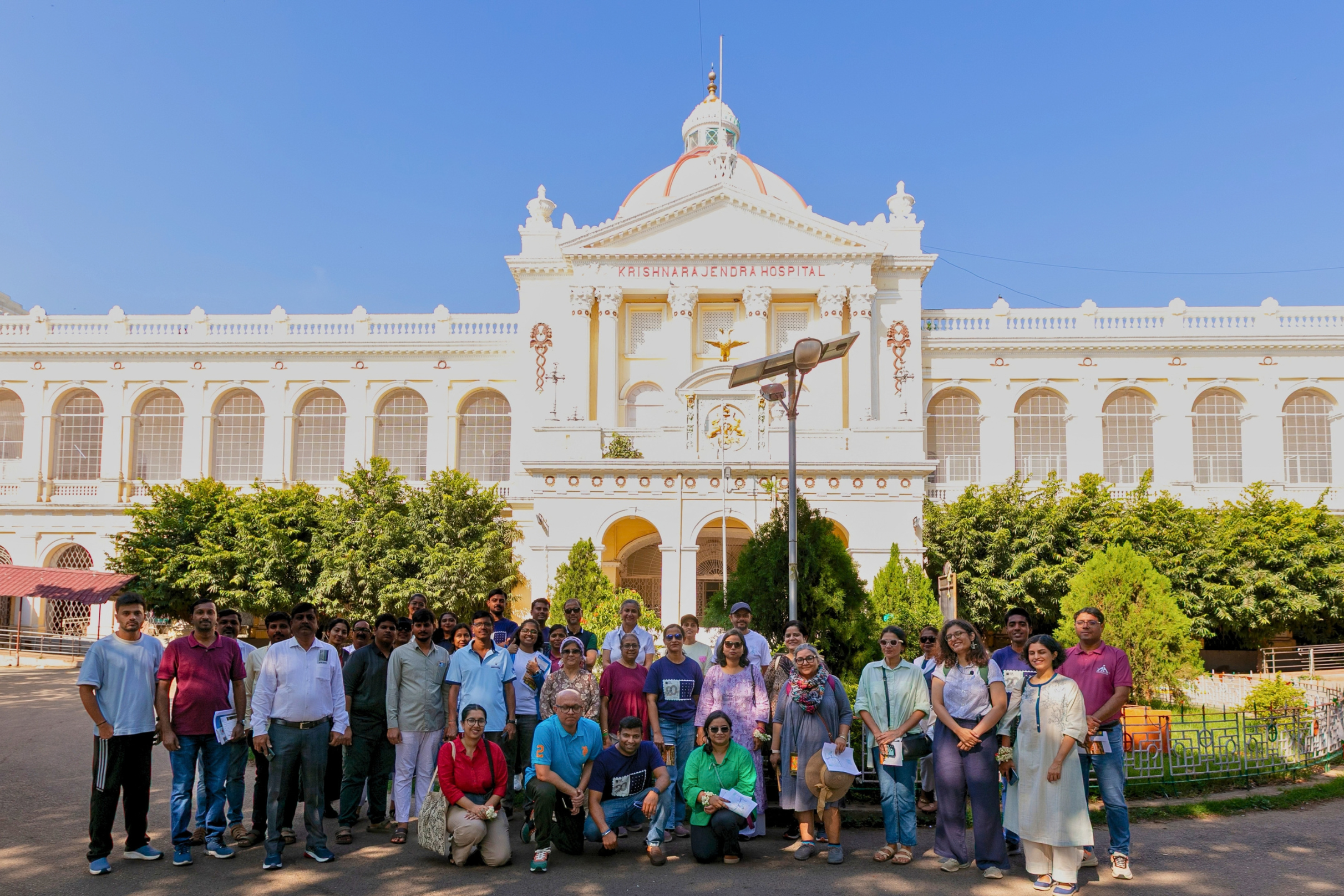
The 2.8-km ‘Markets, Museums and Mysuru’ walk explored nine historic sites, archival memories and traditional puppetry as part of the ‘My City My Heritage’ campaign.
Mysuru’s heritage is often told through its palaces. But a city’s history also lives in its markets, hospitals, public buildings, temples and the stories people leave behind.
That was the idea behind a recent heritage walk in Mysuru, organised by InterGlobe Foundation and IndiGoReach as part of their ongoing ‘My City My Heritage’ campaign. Held in collaboration with Sahapedia and India Foundation for the Arts, the walk took participants through the city’s civic and commercial core under the theme ‘Markets, Museums and Mysuru’.
Led by Aishwarya Kirit and facilitated by Raghuram SK, the 2.8-km walk covered nine historic locations, including Jaganmohan Palace, Lansdowne Building, K.R. Circle, Devaraja Market, K.R. Hospital, Cauvery Emporium, Makkaji Chowk, Sri Subramanyeshwara Temple and Town Hall.
Rather than treating these places simply as architectural landmarks, the walk used archival material from the Star of Mysore to explore how generations of residents experienced them. Newspaper reports, photographs, reader opinions and letters were used to connect the physical spaces with the memories and debates surrounding them.
The programme also moved beyond built heritage. At the historic Jayalakshmi Vilas Mansion, participants were introduced to Mysuru’s cultural traditions and intangible heritage through a traditional string puppetry performance by S.N. Srikanta, a fifth-generation puppeteer.
For the organisers, this broader understanding of heritage is central to the ‘My City My Heritage’ campaign. The initiative seeks to encourage citizens to engage with the histories of their own cities and build greater awareness around the preservation of both tangible and intangible heritage.
Mysuru is the 13th city covered by the campaign. Earlier walks have been held in Prayagraj, Bhubaneswar, Shillong, Nashik, Hyderabad, Kozhikode, Lucknow, Chhatrapati Sambhajinagar, Ahmedabad, Puducherry, Gwalior and Patiala.
“India’s history is a living legacy,” Rohini Bhatia, Chairperson of InterGlobe Foundation, said, adding that the Mysuru walk brought together archival histories, urban spaces and traditional art forms to highlight the different layers of the city’s identity.
IndiGo CEO Willie Walsh said the initiative was intended to encourage people to rediscover the cultural narratives of Indian cities, adding that the company’s engagement with communities extends beyond connecting destinations.
The Mysuru walk is part of a wider set of heritage conservation efforts undertaken by the two organisations. InterGlobe Foundation has supported projects including the conservation of Abdur Rahim Khan-I-Khanan’s mausoleum in Delhi, cultural mapping and documentation across 18 cities, restoration of the Indra Kund stepwell in Delwara and restoration work at Qutb Shah’s Mausoleum. IndiGoReach has supported conservation work at the Qutb Shahi Heritage Park in Hyderabad and restoration of the interiors of Lal Bagh Palace in Indore.
The larger question for such initiatives is not only how historic structures can be preserved, but how people continue to recognise them as part of their own lives. In Mysuru, the walk attempted to make that connection through places people pass every day, archival records that preserve older memories and artistic traditions that continue to be practised.
For a heritage campaign, that may be just as important as the monuments themselves: making a city’s history something its residents can encounter, rather than something they only visit.